

China is one of the major manufacturing bases for safety footwear. For importers, distributors, wholesalers, workwear companies, and private-label brands, buying safety shoes from China can provide a wide choice of styles, materials, safety features, and customization options.
However, importing safety shoes is not simply about finding the lowest price. Product standards, factory capability, quality control, shipping, and local import requirements all need to be considered. Here is a practical step-by-step guide.

Define Your Product Requirements
Before contacting suppliers, clearly define what you need.
Consider:
Steel, composite, or plastic toe
Puncture-resistant midsole
Slip resistance
Oil resistance
Anti-static or ESD performance
Waterproof protection
Upper and outsole materials
Size range
Colors and design
Logo and packaging
Target quantity
A clear specification makes it easier to compare quotations from different factories and avoid misunderstandings during production.
Find the Right Chinese Factory
You can find suppliers through B2B platforms, trade fairs, industry websites, or direct factory websites.
When evaluating a supplier, check whether it is a real manufacturer and whether its production capability matches your project.
Ask for:
Factory profile
Production capacity
Product range
Main export markets
Certifications
Test reports
Quality-control procedures
Sample policy
MOQ
Production lead time
Do not choose a supplier based only on the lowest quotation. Different materials, construction methods, packaging, and safety requirements can create significant price differences.
Check Safety Standards and Certifications
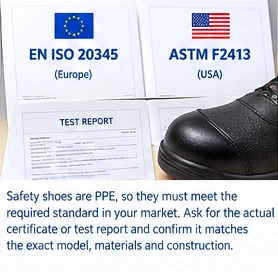
Safety footwear is personal protective equipment, so the required standard depends on your target market.
For example, EN ISO 20345 is widely used in European markets, while ASTM F2413 is commonly specified in the United States.
Always ask the supplier for the actual certificate or test report and check whether it applies to the exact shoe model you are buying.
If you change the toe cap, outsole, midsole, materials, or construction after testing, the original documentation may no longer fully represent the final product.
Order Samples First
Never place a large order based only on photos.
A physical sample allows you to check:
Size and fitting
Upper material
Toe-cap position
Stitching
Sole attachment
Flexibility
Weight
Comfort
Logo placement
Packaging
For private-label projects, the approved sample should become the reference for mass production.
Confirm MOQ, Price and Payment Terms
Chinese factories normally offer both stock products and customized production.
Stock products may be available in small quantities, while OEM projects usually require a higher MOQ. For example, a custom project may have an MOQ of 500 pairs per style, depending on the factory and materials.
Typical OEM terms may include:
Payment: 30% deposit + 70% balance before shipment
Lead time: approximately 30–50 working days, depending on quantity and customization
These are only examples. Always confirm the final terms with your supplier before placing an order.
Calculate Your Total Landed Cost
The factory quotation is not your final cost.
Your total import cost may include:
| Cost | What to Consider |
|---|---|
| Product price | Price per pair |
| Packaging | Shoebox and export carton |
| Testing | Product testing or certification |
| Inspection | Factory or third-party inspection |
| Inland freight | Factory to port |
| International freight | Sea or air shipping |
| Customs | Clearance and broker fees |
| Import duty | Destination-country tariff |
| VAT/GST | Local taxes |
| Delivery | Port to your warehouse |
Ask your freight forwarder or customs broker to calculate the expected landed cost before confirming the order.
Choose the Shipping Method
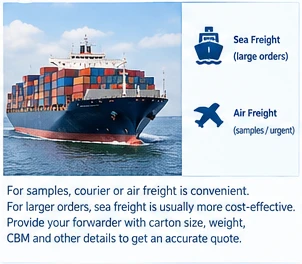
For samples, courier or air freight is usually convenient.
For larger commercial orders, sea freight is often more suitable because safety shoes take considerable carton volume.
Before booking transportation, obtain:
Number of cartons
Carton dimensions
Gross weight
Net weight
Total CBM
Pairs per carton
Port of loading
This information allows your forwarder to calculate the freight accurately.
Inspect Before Shipment
A pre-shipment inspection can help reduce problems after the goods leave China.
The inspection should check:
Quantity
Sizes
Colors
Materials
Logo
Stitching
Outsole
Packaging
Carton markings
Overall workmanship
For large orders, buyers can also agree on quality standards and inspection requirements with the factory before production begins.
Prepare Import Documents
Depending on your destination, common documents may include:
Commercial invoice
Packing list
Bill of lading or air waybill
Certificate of origin when required
Product certificates
Test reports
Declaration of Conformity where applicable
Customs documents
Import requirements vary by country, so confirm the details with your customs broker before shipment.
Build a Long-Term Supplier Relationship
A good supplier should be more than a source of low prices.
For long-term cooperation, discuss product improvements, new materials, custom colors, private labels, packaging, testing, and repeat orders.
After receiving your shipment, collect customer feedback and record any problems with sizing, materials, workmanship, or packaging. This information can help the factory improve future orders.
Conclusion
Importing safety shoes from China becomes much easier when you treat the process as a complete supply chain rather than simply a product purchase. Start with clear specifications, choose a suitable factory, verify safety requirements, approve samples, control production quality, and calculate all import costs before shipment.
For B2B buyers, these steps can help reduce purchasing risks and create a more stable supply of safety footwear for wholesale, distribution, and private-label business.


