

In electronics manufacturing, semiconductor production, precision instruments, and other specialized industrial environments, workers may come into contact with static electricity every day. Although static electricity is usually invisible and cannot be felt, it can potentially affect electronic components, precision equipment, and even the production environment. Therefore, many companies pay close attention to an important question when choosing work footwear: What are ESD safety shoes?
Simply put, ESD safety shoes are professional work shoes designed to help control the accumulation and discharge of static electricity from the human body. Through the shoe upper, outsole, conductive or antistatic materials, and the body–shoe–floor grounding path, they help release static electricity in a controlled manner, reducing the risk of static discharge affecting sensitive electronic devices and production environments.
It is important to note that ESD safety shoes are not simply the same as ordinary antistatic shoes. If they are also equipped with safety features such as steel toes, composite toes, or puncture-resistant midsoles, they can provide more comprehensive foot protection in addition to static-control performance.
1. What Does ESD Mean?
ESD stands for Electrostatic Discharge.
We encounter static electricity in everyday life. For example, you may hear a "crackling" sound when taking off a sweater in winter, or feel a small electric shock when touching a metal object after walking across a carpet. These are common examples of static electricity.
The human body can generate static electricity through walking, friction, changing clothes, or contact with different materials. In ordinary environments, this static electricity usually does not cause serious problems. However, in electronics manufacturing, semiconductor production, chip manufacturing, and similar environments, even a small static discharge that cannot be felt by a person may potentially damage sensitive electronic components.
For this reason, static control in these workplaces often involves multiple measures, including ESD flooring, ESD workstations, grounding systems, ESD garments, and ESD safety shoes.
2. What Is the Main Function of ESD Safety Shoes?
The most important function of ESD safety shoes is to help control and safely dissipate static electricity from the human body.
The outsoles of ordinary shoes are often relatively insulating. When the human body generates static electricity, electrical charges may accumulate on the surface of the body. Without an appropriate discharge path, the accumulated charge may suddenly discharge when a person touches equipment or another object.
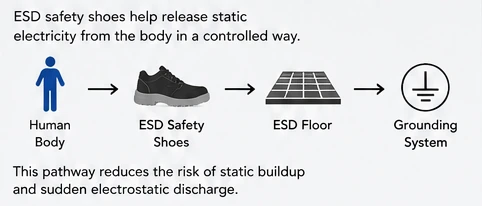
ESD safety shoes use outsole materials with appropriate conductive or antistatic properties and work together with a suitable ESD flooring system. This allows static electricity generated by the human body to be dissipated through the shoes in a controlled manner.
In simple terms:
Human Body → ESD Safety Shoes → ESD Floor → Grounding System
This pathway helps reduce the risk of static buildup and sudden electrostatic discharge.
Therefore, ESD safety shoes are commonly used in workplaces where controlling static electricity is particularly important.
3. What Is the Difference Between ESD Safety Shoes and Ordinary Safety Shoes?
Many people can easily confuse "Safety Shoes" with "ESD Safety Shoes."
Ordinary safety shoes mainly address mechanical hazards, such as falling objects, foot compression, punctures from sharp objects, and slipping in the workplace.

ESD safety shoes, on the other hand, can combine these basic foot-protection functions with static-control performance that meets the applicable requirements. In other words, they can provide both foot protection and electrostatic control.This makes ESD safety shoes a practical choice for workplaces that require both safety protection and static control.
4. Which Industries Need ESD Safety Shoes?
ESD safety shoes are not required in every workplace. However, they can be particularly important in industries where electronic components and equipment are sensitive to electrostatic discharge.
Electronics Manufacturing
Electronic components, PCBs, circuit boards, chips, and other products can be sensitive to static electricity. Workers may frequently handle electronic products during manufacturing, assembly, and inspection, making a comprehensive ESD protection system important.
Semiconductor Industry
Semiconductor manufacturing has strict requirements for environmental control. During the production and inspection of wafers, chips, and related electronic components, controlling electrostatic conditions is an important part of workplace management.
Precision Instrument Industry
Some precision instruments contain large numbers of sensitive electronic components. ESD safety shoes can be used as one part of the personnel static-control measures in these working environments.
Laboratories
Some electronics laboratories, R&D centers, testing facilities, and other specialized workplaces may also use ESD protection products as part of their static-control procedures.
Pharmaceutical and Specialized Manufacturing
Some companies with specific production-environment requirements may also use ESD work shoes based on their own risk assessments, workplace standards, and management requirements.

5. Can ESD Safety Shoes Replace Other ESD Protection Equipment?
No.
This is an important point to understand when purchasing ESD safety shoes. ESD safety shoes are only one part of an overall electrostatic control system. Simply wearing ESD shoes does not mean that static electricity will never be generated.
In actual working environments, companies may need to combine ESD safety shoes with measures such as:
ESD flooring
Grounding systems
ESD workwear
ESD gloves
ESD wrist straps
ESD workstations
Employee training
Regular testing and inspection
Only when these different measures work together can a more complete ESD protection environment be established.
6. Can Zstep Provide Customized ESD Safety Shoes?
As a professional safety shoe manufacturer, Zstep can provide ESD safety shoe solutions according to customers' working environments and market requirements.
We can select different upper materials, outsole materials, safety toe caps, puncture-resistant midsoles, insoles, and lining materials according to customer requirements. We also support customization of logos, colors, shoe designs, and other product details.
For customers who require bulk purchasing, private labeling, OEM, or ODM cooperation, Zstep can develop suitable product solutions based on the specific application environment and protection requirements.


