

Choosing the correct Safety Footwear Size is one of the most important factors when purchasing work shoes. Even the most protective footwear cannot perform properly if the fit is incorrect. Since safety shoes are often worn for long shifts and physically demanding tasks, proper sizing directly affects comfort, protection, and work efficiency.
Why Safety Footwear Size Is More Important Than Most People Think
Most employees think that since they are familiar with their normal sneaker sizes, all it takes to buy the same size of safety shoes would be to do so. The actuality is that safety shoes are made in a different fashion than casual shoes.
The protective toe caps, puncture resistant midsoles, reinforced heel structures and thicker outsole constructions all have an effect on the internal dimensions of the shoes. Consequentially, two pairs of footwear which are marked as the same size can also be entirely different when worn.
Inappropriate safety footwear is likely to cause various problems. The shoes which are much tighter might squeeze the toes, impair circulation, and produce painful pressure points. This could lead to the formation of blisters, calluses and even chronic foot problems with time.
Conversely, shoes that are too large permit the foot to move around within the footwear as one goes through a motion. It does not provide stability, raises friction and makes the worker susceptible to slips, trips and fatigue.
An adequately fitted pair of safety shoes will help spread the body weight evenly, enhance the balance, and enable the protective properties to work in a way that they are designed to.
The Best Time to Measure Your Feet
One of the most overlooked aspects of sizing is timing.
It is natural that human feet will expand over the course of the day. Walking, standing and general activity can lead to an increase in the volume of feet. It implies that the measurements made on the first morning might not be accurate when depicting the measurement of your feet during a regular working day.
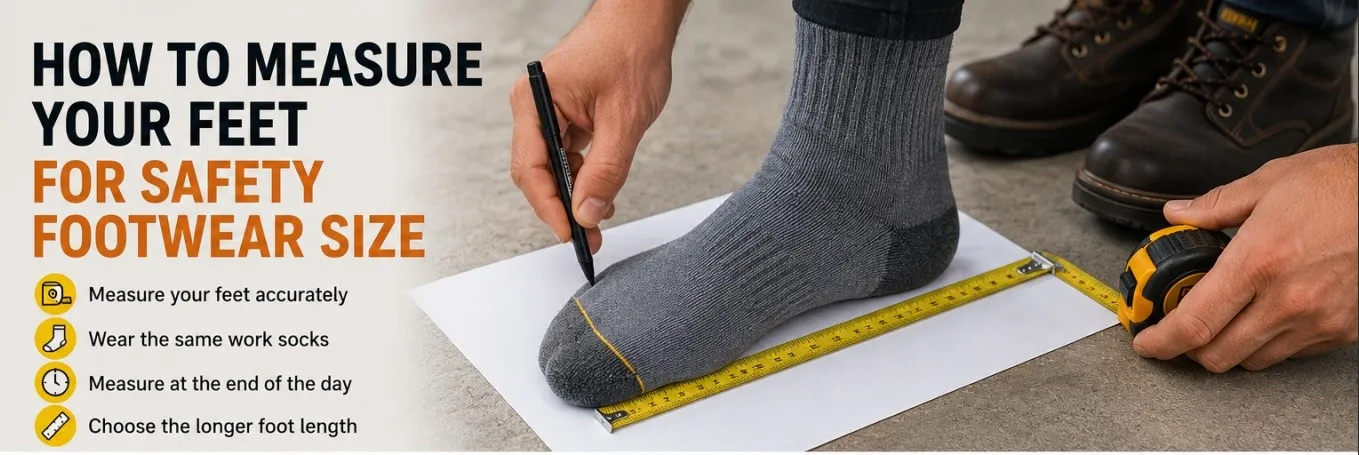
In order to obtain the most precise measurements, you should take measurements of your feet in the late evening or afternoon. Your feet will probably be of the greatest size at this hour, which allows you to choose the shoes that are comfortable all day long.
Such a trivial measure will facilitate avoiding buying shoes which were comfy at first but got tight in a few hours of use.
Wear the Same Socks You Use at Work
Socks play a much bigger role in sizing than many people realize.
Thicker socks are common attire among workers to use them as cushioning, manage moisture or as a cold weather protector. There is a chance of getting wrong sizes when measuring your feet when you are not wearing shoes.
When you are about to measure, wear the same kind of socks that you are going to use with your safety boots. It enables you to take into consideration the extra space in the shoe and makes it more likely that you will get a proper fit.
This step is especially important to workers in colder workplaces who wear thermal or heavy-duty work socks.
How to Measure Foot Length Accurately
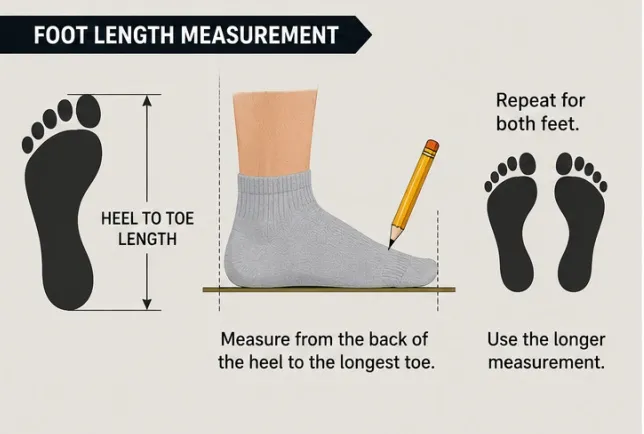
The easiest method to take measurements of your feet at home is by using a piece of paper, a pencil, and a ruler.
Put the paper on a hard surface such as a flat floor and place your feet on it with an even distribution of your body weight. Draw the outline of your foot or indicate the location of your heel and the longest toe.
Using a ruler or a measuring tape measure the distance between these two points. Then repeat this procedure with the other foot.
It is surprising to find out that in many people, one foot is a little bigger than the other. It is perfectly normal. When choosing safety shoes, you should always take the measurement of the larger foot as the measurement to follow.
Selecting the size of shoes depending on the smaller foot usually causes discomfort and extra pressure on the bigger one.
Foot Width Matters Just as Much as Length
Length is only one part of proper footwear sizing.
There are some employees who have a naturally high foot size whereas others have small feet sizes or more arches. Disregarding foot width may lead to buying shoes that should theoretically fit the right length, but will remain uncomfortable when worn regularly.
An employee with large feet can be subjected to pressure on the edges of the foot, whereas an individual with a high arch will have too much tightness at the upper part of the shoe.
Most of the professional safety footwear producers will provide various widths to ensure that they are suitable to use with different types of feet. Where possible, looking at width specifications will be greatly beneficial in terms of comfort and fit.
Choosing the correct Safety Footwear Size is not only about comfort - it directly influences safety, productivity, and long-term foot health.
By measuring correctly and selecting footwear that matches both foot shape and work requirements, workers can enjoy better protection, improved comfort, and more reliable performance throughout every shift.


