

In modern industrial workplaces, safety shoes protect workers from impact, punctures, and other hazards. Some safety shoes also help control static electricity, making them suitable for electronics manufacturing and other specialized environments.
ESD and antistatic safety shoes are related, but they are not exactly the same. Understanding their differences helps importers, wholesalers, and PPE distributors select suitable products for their customers.
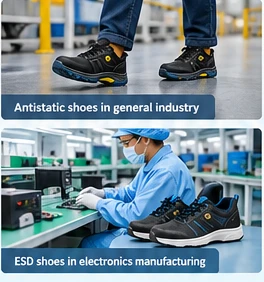
What Are Antistatic Safety Shoes?
Antistatic safety shoes are designed to reduce static electricity accumulation and allow electrical charges to dissipate in a controlled manner.
Under EN ISO 20345, antistatic footwear generally has an electrical resistance between 100 kΩ (10⁵ Ω) and 1,000 MΩ (10⁹ Ω).
These shoes are commonly used in manufacturing, warehouses, workshops, and other industrial environments where static control is required.
Key features include:
Controlled electrical resistance
Steel or composite toe protection
Various materials and designs
Compatibility with different industrial applications
Antistatic shoes are not designed to protect workers from electric shock caused by live electrical circuits.
What Are ESD Safety Shoes?
ESD stands for Electrostatic Discharge. ESD safety shoes are designed to help control electrostatic charges and reduce the risk of damaging sensitive electronic components.
They are commonly used in electronics assembly, semiconductor manufacturing, circuit board production, and ESD-protected areas.
Relevant standards include:
IEC/EN 61340-4-3
EN 61340-5-1
Many ESD programs use a person–footwear–floor system resistance limit of less than 35 MΩ, although specific requirements vary according to the standard and testing method.
ESD footwear must be used with suitable flooring and grounding procedures to provide effective electrostatic control.
Key Differences Between ESD and Antistatic Shoes
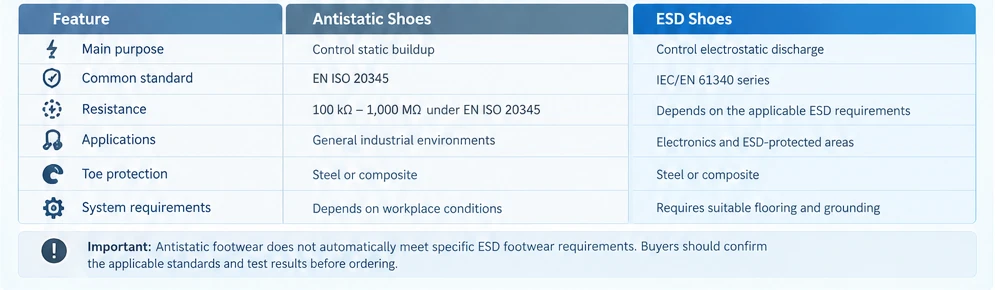
| Feature | Antistatic Shoes | ESD Shoes |
|---|---|---|
| Main purpose | Control static buildup | Control electrostatic discharge |
| Common standard | EN ISO 20345 | IEC/EN 61340 series |
| Resistance | 100 kΩ–1,000 MΩ under EN ISO 20345 | Depends on the applicable ESD requirements |
| Applications | General industrial environments | Electronics and ESD-protected areas |
| Toe protection | Steel or composite | Steel or composite |
| System requirements | Depends on workplace conditions | Requires suitable flooring and grounding |
Important: Antistatic footwear does not automatically meet specific ESD footwear requirements. Buyers should confirm
How Do ESD Safety Shoes Work?
the applicable standards and test results before ordering.
ESD safety shoes help provide a controlled path for static charges to dissipate from the wearer through the footwear and suitable flooring.
The basic process is:
Human Body → ESD Footwear → ESD Flooring → Grounding System
However, ESD shoes cannot provide effective personnel grounding on their own. Their performance depends on the complete system, including flooring, footwear condition, and the workplace's ESD control procedures.
For example, a worker may wear compliant ESD footwear, but an unsuitable floor or contaminated outsole can affect the overall grounding path.
Therefore, factories should establish appropriate testing and maintenance procedures. Some ESD-protected workplaces require footwear testing when workers enter the controlled area.
Where Are ESD and Antistatic Shoes Used?
Different workplaces have different electrical safety requirements.
Antistatic Safety Shoe Applications
Antistatic footwear may be used in:
General manufacturing
Warehouses and logistics
Industrial workshops
Chemical-related working environments
Certain areas where static buildup and spark risks must be controlled
The appropriate footwear depends on the workplace risk assessment and applicable safety requirements.
ESD Safety Shoe Applications
ESD footwear is commonly used in:
Electronics assembly factories
Semiconductor manufacturing
Circuit board production
Electrical component inspection
ESD-protected production areas
Certain cleanroom environments
Not every workplace requires ESD footwear. Buyers should identify the customer's technical requirements before selecting a product.
How to Choose the Right Safety Shoes for Your Business
For importers and wholesalers, selecting suitable footwear requires more than checking the product's appearance or price.
1. Confirm the Application
Ask the customer where the shoes will be used.
Are they intended for general industrial work, electronics assembly, or an ESD-protected area?
2. Check the Required Standards
Confirm whether the customer requires:
EN ISO 20345 safety footwear certification
Antistatic performance
ESD testing according to the applicable IEC/EN 61340 requirements
Additional toe and penetration protection
Do not assume that an antistatic marking alone satisfies an ESD-specific requirement.
3. Confirm the Resistance Requirements
Ask the buyer for the required resistance range and test standard.
Different customers may use different specifications, so written confirmation is important before production.
4. Consider Comfort and Protection
ESD footwear can be designed with different materials and safety features, including:
Flyknit or mesh uppers
Steel or composite toe caps
Puncture-resistant midsoles
PU/PU or PU/TPU outsoles
Lightweight sports shoe designs
The final design should match the workplace's protection and comfort requirements.
ESD Safety Shoes from a Manufacturer's Perspective
For safety shoe manufacturers and PPE suppliers, ESD products require careful material selection, production control, and electrical performance testing.
Factors that may influence footwear resistance include:
Outsole material
Insole and lining materials
Conductive components
Moisture and environmental conditions
Product construction
Contact between footwear and flooring
A shoe's electrical performance must be verified through the appropriate testing process rather than assumed from its materials alone.
For OEM and private-label projects, buyers should confirm the required standards, testing documentation, product specifications, and labeling requirements before mass production.
At ZSTEP, we focus on safety footwear production and customized solutions for international buyers. Depending on the project, product design, safety protection, and testing requirements can be discussed with our technical team.


